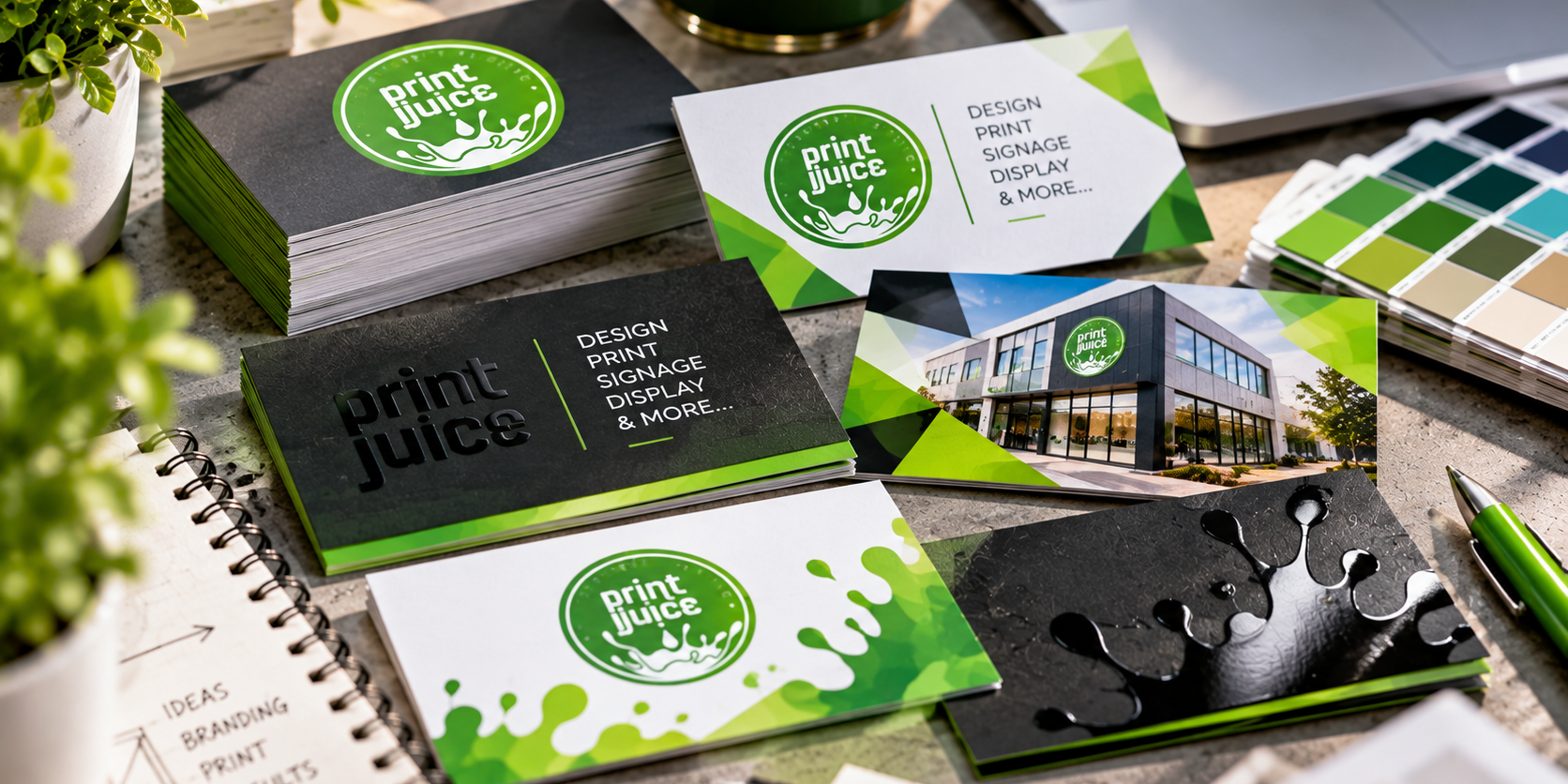
What Makes a Good Business Card? 10 Design & Printing Tips
Websites, email and social media haven’t made the business card disappear.
When you meet a potential customer, attend an event or visit a client, a well-designed card still gives somebody an immediate and convenient way to remember who you are, what you do and how to contact you.
But a good business card isn’t simply your contact details squeezed onto a rectangle.
It needs to be easy to read, consistent with your brand and appropriate for the type of business you run.
Here are ten practical things to think about before sending your next set of business cards to print.
A Good Business Card Should Do Four Things
1. Decide What Really Needs to Be on the Card
Space on a business card is limited, so don’t start by trying to fit everything on it.
For many businesses, the essentials will be:
- Your logo or business name
- Your name
- Your role or job title where useful
- Telephone number
- Email address
- Website
- A short description of what the business does if needed
Additional information can be useful, but it needs to earn its place.
Print Juice provides professional business card printing with artwork and design support available.

2. Make the Important Information Easy to Read
A business card isn’t the place to prove how tiny you can make a font.
If somebody has to hold the card under a light and squint to find your telephone number, the design has failed at one of its most basic jobs.
Give important information enough size, space and contrast to remain easy to read.
Decorative typefaces can work as part of a brand identity, but they’re not always suitable for every line of contact information.
Clarity beats cleverness when somebody is trying to find your phone number.
3. Create a Clear Visual Hierarchy
Not every element on the card needs to be the same size.
Your logo or company name might be the strongest visual element, followed by your name and then the contact information.
Size, weight, position and spacing can all tell the eye what to look at first.
Without hierarchy, a business card can become a collection of unrelated bits of text fighting for attention.
4. Don't Fill Every Millimetre
Business cards are small, which makes it tempting to use every available piece of space.
Resist the temptation.
Space around your logo and contact information can make the whole design easier to understand and give the card a more professional appearance.
The same principle applies to brochures, flyers and other printed marketing: empty space isn’t automatically wasted space.
Need New Business Cards?
Print Juice can produce professional business cards to match your existing branding, with artwork and design support available if you need help preparing the card for print.
5. Use Both Sides When It Makes Sense
The back of the card gives you useful additional space, but that doesn’t mean it needs to become a second front.
One approach is to keep one side visually simple — perhaps the logo and brand identity — while the other carries the practical contact information.
Alternatively, the reverse could contain a useful call to action, QR code or short list of key services.
The right approach depends on the business and what you want the card to achieve.
6. Keep It Consistent With the Rest of Your Branding
Your business card shouldn’t look unrelated to the rest of your company.
Use the same logo, colours and visual identity customers see on your website, business signage, brochures and other marketing.
That consistency makes the company easier to recognise and gives your marketing a more joined-up appearance.
If your existing identity has become inconsistent over time, our branding and rebranding service can help create a clearer visual direction before producing new print.
7. Think About the Card Stock and Finish
A business card is one of the pieces of marketing your customer physically handles, so the material matters as well as the artwork.
The weight, surface and finish can all affect how the finished card looks and feels.
The right choice isn’t automatically the most elaborate option. It should suit the design, brand and intended use.
A clean professional card on an appropriate stock can be far more effective than adding finishes simply for the sake of having them.
8. Should You Put a QR Code on a Business Card?
A QR code can be useful if it saves the recipient effort.
It could link directly to:
- Your website
- A contact page
- An online portfolio
- A booking page
- A digital menu or product range
- Another relevant online destination
But don’t add a QR code just because there’s an empty corner.
Give it a useful destination and make sure there’s enough space around it to scan reliably.
Always test the final QR code before approving the artwork for print.
9. Check Every Detail Before Printing
A spelling mistake in a paragraph on a website can be corrected in a few minutes.
A wrong telephone number on hundreds of printed business cards is rather less convenient.
Before approving the artwork, check:
- Your name and job title
- Business name
- Telephone numbers
- Email address
- Website address
- Postal address, if included
- Social details, if included
- QR codes
- Spelling and punctuation
Then get somebody else to check it as well. When you’ve been staring at the same artwork for an hour, it’s surprisingly easy to read what you expect to see rather than what’s actually there.
10. Design for Print, Not Just the Screen
A design looking good on your monitor doesn’t automatically mean the file is ready for professional printing.
The artwork needs to be prepared with the finished printed size, image quality and production requirements in mind.
Logos and graphics should be supplied in the best available format, and images shouldn’t simply be copied from a website and enlarged.
If you’re unsure about your artwork, speak to your printer before placing the order rather than discovering a problem after production.
Common Business Card Mistakes to Avoid
Make Your Business Cards Part of the Bigger Picture
A business card works best when it feels like one part of a consistent set of business materials.
The same identity can carry across your brochures, flyers and leaflets, signage and other printed marketing.
If somebody receives your card at an event and visits your website later, the branding should make the connection obvious.
That’s when an individual piece of print becomes part of a recognisable business identity rather than just another card in somebody’s pocket.
Business Card Checklist Before You Print
- Is the business name or logo immediately clear?
- Can somebody tell what the business does?
- Is your name easy to find?
- Are the telephone number and email easy to read?
- Is the website address correct?
- Is there enough space around the important elements?
- Does the card match your existing branding?
- Are the logo and images suitable quality?
- Have you checked both sides of the artwork?
- Have any QR codes been tested?
- Has somebody else proofread the card?
Ready for New Business Cards?
Print Juice provides professional business card printing for companies, tradespeople and professionals, with artwork and design support available when required.
Based near Bishop’s Stortford, we’re a family-run print business with decades of experience producing professional printed materials for businesses.
Call 01245 860 550 or send us your requirements and we’ll help you get your next set of business cards into print.