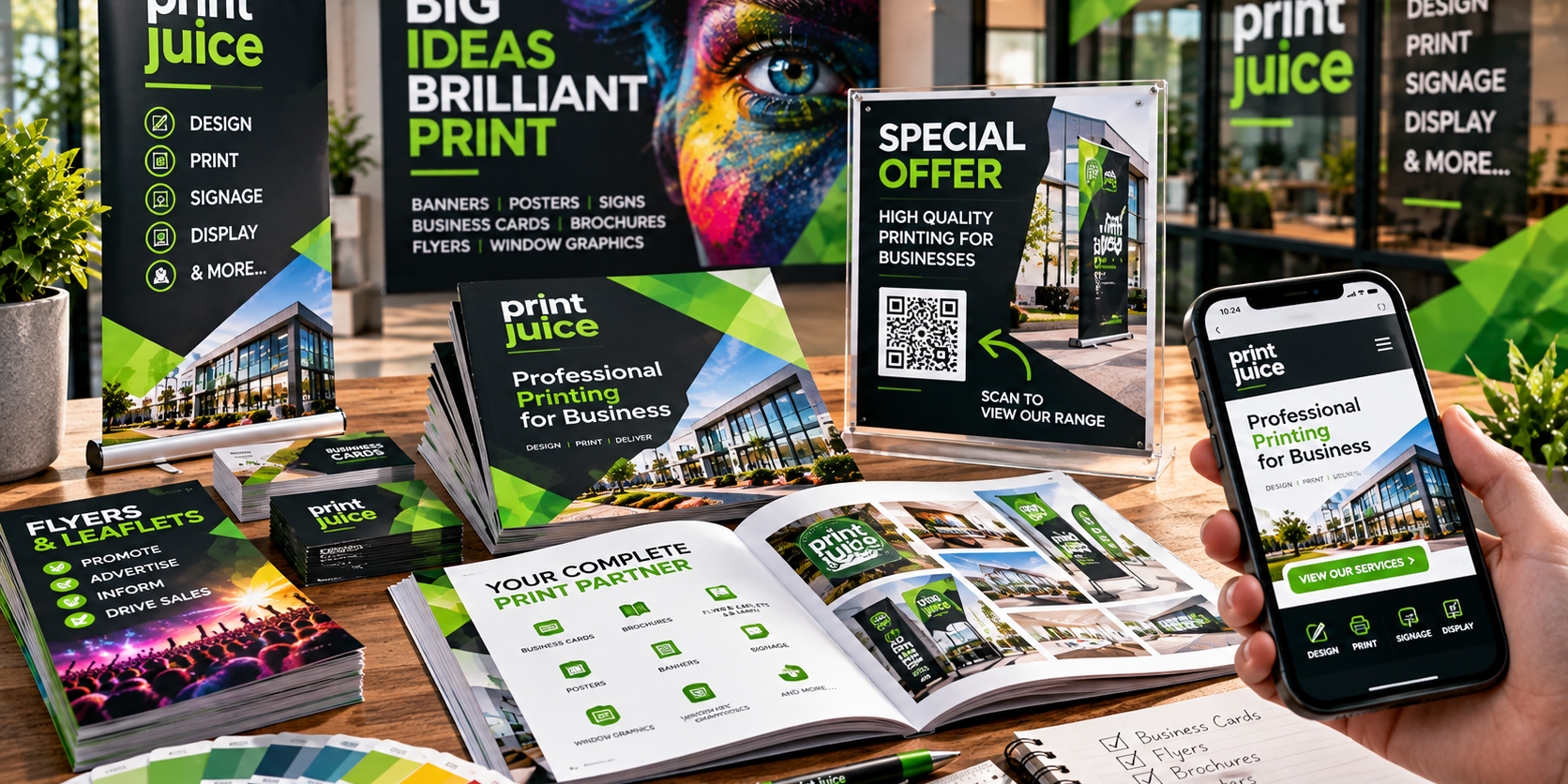
Does Print Marketing Still Work? 10 Ways Businesses Can Use Print in 2026
Does print marketing still work?
It’s a reasonable question when so much business communication now happens through websites, search engines, email and social media.
But walk into a shop, attend an exhibition, open a parcel, visit a business premises or meet somebody at a networking event and printed marketing is still everywhere.
The important thing is that print doesn’t need to replace digital marketing.
Some of the most useful campaigns connect the two.
A poster gets somebody’s attention. A QR code takes them to a website. A brochure gives a sales prospect something tangible to keep. A business card makes it easy to remember the person they met.
Here are ten practical ways businesses can still put print to work.
Print and Digital Don't Have to Compete
1. Turn Business Cards Into a Route Back to Your Website
A business card doesn’t need to contain everything about your company.
Its job can be much simpler: remind somebody who they met and give them an easy route to the next step.
Alongside your name, telephone number and email, include a clear website address or a useful QR code where appropriate.
That could send somebody to your homepage, portfolio, booking page or another destination relevant to the conversation you’ve just had.
Our guide to what makes a good business card covers the design side in more detail.
Print Juice also provides professional business card printing.

2. Use Flyers and Leaflets to Drive a Specific Action
Flyers and leaflets work best when they have a clear job.
Promote an opening. Advertise an event. Introduce a service. Highlight a special offer. Launch a new product. Encourage somebody to request a quote.
Then connect that printed message to the appropriate online destination.
Rather than simply sending everyone to your homepage, a campaign can direct people to the exact page containing the information or action promised in the printed piece.
If you’re unsure which format suits the campaign, see our guide to flyers vs leaflets or explore our flyer and leaflet printing.
3. Give Sales Prospects a Brochure They Can Keep
A website can hold enormous amounts of information, but that’s not always what you need during a meeting or sales conversation.
A well-structured brochure can present a selected set of services, products, case studies or company information in a format the customer can take away.
The brochure can then direct readers online when they want more detail.
This works particularly well when the printed piece and website share the same branding, language and imagery.
Read our guide on how to create a business brochure people actually read or view our brochure printing service.
Planning a Print Marketing Campaign?
From business cards and brochures to posters, banners, boards and signage, Print Juice can help you create professional printed materials that work alongside the rest of your marketing.
4. Use Posters to Make One Message Hard to Miss
Digital advertising can reach people while they’re looking at a screen. A poster can communicate with them while they’re somewhere else entirely.
That might be inside a shop, at an event, in a reception area or in another suitable display location.
The key is simplicity.
Someone walking past a poster doesn’t have the same amount of time as somebody deliberately reading a webpage.
A strong headline, clear visual and obvious next step can therefore be much more useful than a wall of text.
Explore professional poster printing from Print Juice.
5. Make Your Business Premises Part of Your Marketing
If customers visit or pass your premises, the building itself can become part of your marketing.
Business signage can identify the company and communicate what you do, while window vinyls can use existing glass for branding, promotions, information and decorative graphics.
The strongest results usually come when the physical branding matches what customers see online.
If your website is green and modern but your premises use an unrelated logo and completely different colours, you’re making recognition harder than it needs to be.

6. Create a Complete Exhibition or Event Presence
Events are a perfect example of print and digital marketing working together.
A pop up banner can make the stand visible. Brochures and flyers provide more information. Business cards give visitors a direct contact. QR codes can connect them to online content immediately.
The important thing is to treat these as parts of one campaign rather than designing every item separately.
Use consistent colours, messages and calls to action so somebody who later visits your website immediately recognises the company they saw at the event.
7. Use Large Format Print to Get Attention First
Large format printing doesn’t need to communicate every detail of an offer.
Its job may simply be to get somebody’s attention.
PVC banners, advertising boards, posters, signs and flags can deliver the big message. Smaller printed material or your website can then provide the detail.
That creates a simple journey:
Get noticed → create interest → provide more information → make it easy to respond.
Our large format printing guide explains the different options available.
8. Use QR Codes to Connect Physical and Digital Marketing
QR codes provide one of the simplest bridges between print and digital.
A customer sees something interesting in print, scans the code and continues the journey on their phone.
The destination could be:
- A product or service page
- An online booking system
- A contact or quotation form
- A menu
- An event registration page
- A video
- A portfolio or gallery
- A specific promotional landing page
Don’t just add a QR code without context. Tell people why they should scan it.
“Scan to view the full range” gives somebody a reason. A mysterious square on its own doesn’t.
And always test the final QR code before the artwork goes to print.
9. Use Consistent Branding Everywhere
A customer may encounter your business several times before making contact.
They might see a sign, receive a leaflet, visit your website, find your social media and eventually pick up a brochure.
If every one of those touchpoints looks unrelated, you’re losing some of the recognition that consistent branding can create.
Your logo, colours, typography, imagery and tone don’t have to be identical in every application, but they should clearly belong to the same business.
If the identity itself needs attention, see our branding and rebranding service.
10. Give Every Piece of Print a Job
One of the simplest ways to improve print marketing is to stop producing things simply because “we’ve always had them”.
Before creating any printed material, ask:
- Who is this for?
- Where will they see or receive it?
- What is the main message?
- What do we want them to do afterwards?
- Does print suit that job?
- Should it connect to an online page or action?
- How will we know whether the campaign generated enquiries?
Those questions help determine whether you need a flyer, brochure, poster, banner, business card, sign — or perhaps no printed piece at all.
Start with the objective and choose the format afterwards.
Can You Measure Print Marketing?
Print isn’t automatically unmeasurable.
Depending on the campaign, businesses can use dedicated landing pages, QR codes, campaign-specific offers, enquiry questions or other tracking methods to understand what generated a response.
For example, instead of putting only your homepage address on a targeted leaflet, you could direct readers to a dedicated page related to that particular offer.
The important thing is to decide how you’ll measure the campaign before the material is printed and distributed.
Don't Let Poor Artwork Undermine a Good Campaign
Even a strong campaign idea can be let down by poor-quality images, incorrect dimensions, tiny text or files that haven’t been prepared properly for print.
Before supplying your files, read our guide to preparing artwork for professional printing.
It covers image resolution, bleed, trim, fonts, colour, PDFs, QR codes and the final checks worth making before approving a job.
Print Marketing Checklist
- Define the audience before designing the material.
- Give each printed item one clear primary purpose.
- Use consistent branding across print and digital.
- Choose the printed format according to how it will be used.
- Keep the main message clear and easy to understand.
- Include an obvious next step or call to action.
- Use URLs or QR codes where they genuinely help the customer.
- Send people to the most relevant webpage rather than automatically using the homepage.
- Use suitable quality artwork and images.
- Proofread everything before printing.
- Test QR codes and online destinations.
- Decide how you’ll measure responses where possible.
Ready to Put Print to Work for Your Business?
Print Juice provides professional digital and large format printing for businesses and organisations, including business cards, brochures, flyers, posters, banners, boards, signage and promotional displays.
Based near Bishop’s Stortford, we’re a family-run print business with decades of industry experience.
Call 01245 860 550 or tell us what you’re planning and we’ll help you turn the idea into professional printed material.