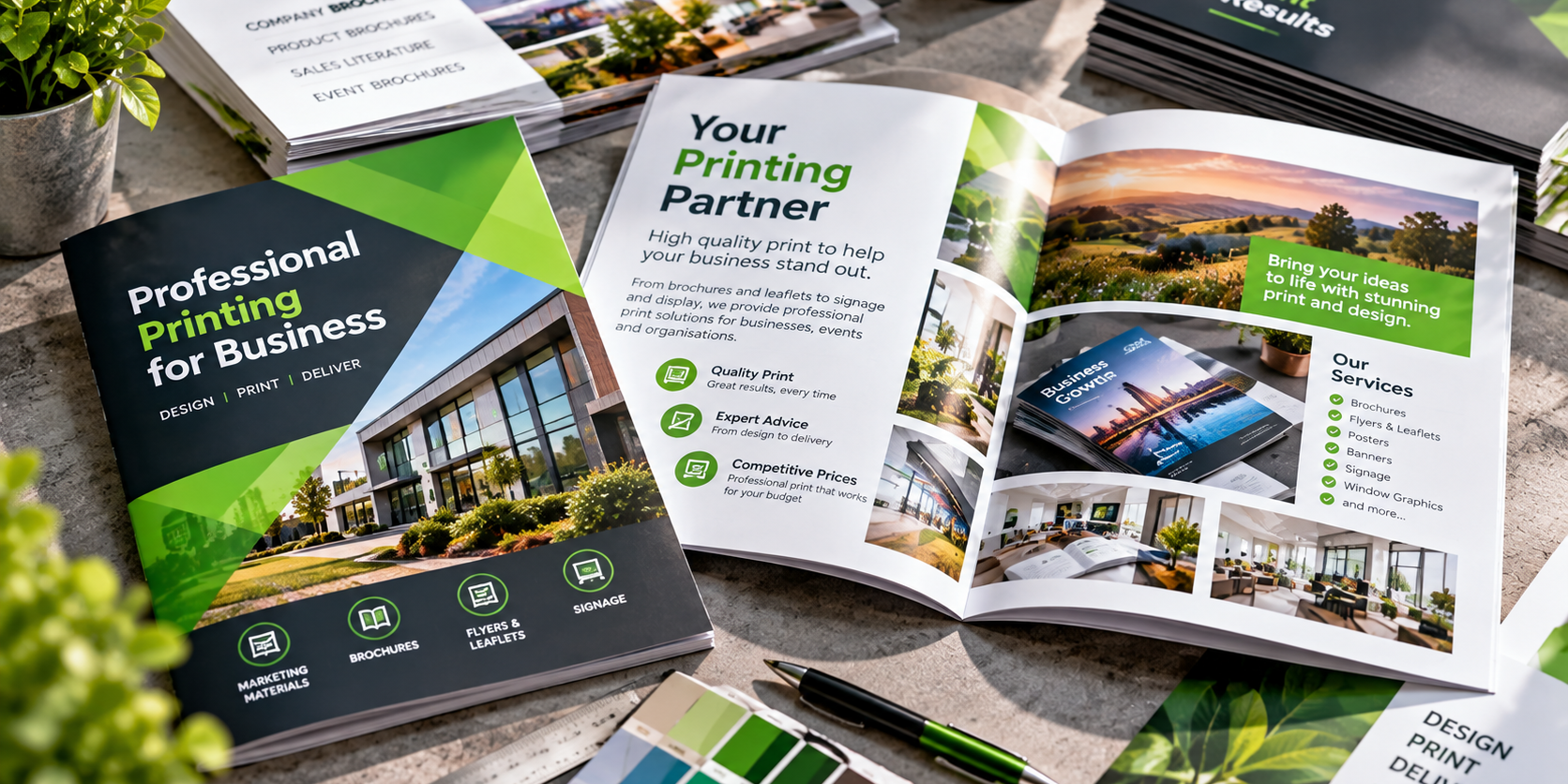
How to Create a Business Brochure That People Actually Read
A professionally printed brochure can introduce your company, explain your services, showcase products and give potential customers something useful to keep after a meeting, event or enquiry.
But there’s an important difference between having a brochure and having a brochure that actually does its job.
Trying to squeeze your entire website into a few printed pages rarely produces the best result.
The strongest brochures have a clear purpose, a sensible structure, good imagery and an obvious next step for the reader.
Here’s how to plan one.
Before You Start: Answer These Four Questions
1. Give Your Brochure One Clear Purpose
The easiest way to create a confused brochure is to start writing before deciding what it’s supposed to achieve.
A company brochure aimed at introducing your business has a different job from a product catalogue or an exhibition handout.
Decide what the brochure should help the reader understand or do.
That decision makes everything else easier: what goes on the cover, which sections deserve the most space, which photographs you need and what call to action belongs at the end.
Print Juice provides professional brochure printing for company, product, sales and marketing brochures.

2. Make the Cover Earn the Next Page
The cover doesn’t need to explain your entire business.
Its first job is to make the right person interested enough to open the brochure.
Your logo will usually belong there, but don’t assume the company name alone is enough. A short headline or supporting message can tell the reader why the brochure is relevant to them.
Compare:
“ABC Engineering Ltd”
with:
“Precision Engineering for UK Manufacturers”
The second immediately gives the reader some context.
Strong imagery can help too, provided it relates to the company, product or outcome you’re actually selling.
3. Give the Content a Logical Structure
People don’t necessarily read a brochure from the first word to the last.
They scan headings, notice images and jump to sections that look relevant.
A straightforward company brochure might follow this structure:
- Front cover: Brand, headline and strong visual.
- Introduction: Who you are and why the reader should care.
- Services or products: Organised into clear, easy-to-scan sections.
- Why choose you: Genuine reasons customers work with your business.
- Proof: Examples, testimonials, experience or relevant credentials where appropriate.
- Call to action: Tell the reader what to do next.
- Contact details: Make it easy to take that action.
That isn’t a rigid template. The important thing is that the reader can understand the story without having to work out where you’ve hidden the useful information.
4. Write for the Customer, Not the Company
Your company obviously needs to appear in its own brochure, but try reading the finished copy from the customer’s point of view.
Can they quickly understand what you do, whether it’s relevant to them and why they should continue reading?
Planning a New Company Brochure?
Whether you’re producing a company brochure, product brochure or sales presentation, Print Juice can help turn your artwork and ideas into professional printed material.
5. Use Images That Add Something
Photographs can transform a brochure, but only when they have a reason to be there.
For a product business, good product photography may be essential. For a contractor, finished projects can demonstrate the type and standard of work. For a service business, relevant imagery can help explain an otherwise intangible service.
Where possible, use genuine photography from the business rather than filling every available space with generic stock images.
And remember that an image that looks acceptable as a small picture on a website may not be suitable for a large printed page.
Start with the best quality original images available.
6. Keep the Design Consistent With Your Brand
Your brochure shouldn’t look as though it belongs to a completely different company from your website, business cards and signage.
Use your established colours, logo, typography and overall visual style to create continuity between the brochure and the rest of your marketing.
Consistency helps make your business more recognisable and gives individual pieces of marketing a much more professional feel.
If the existing identity isn’t strong enough to support that consistency, consider whether branding or rebranding needs addressing before creating a major new set of marketing materials.
7. Don't Be Afraid of White Space
You’ve paid for the whole page, so surely you should fill every inch of it?
No.
White space gives the important elements room to breathe. It separates sections, improves readability and can make a design feel considerably more polished.
If every gap is filled with another photograph, logo, badge, paragraph or graphic, the reader has no obvious place to look.
Space is part of the design.
8. Make It Easy to Scan
Long uninterrupted walls of text are hard work.
Break the information into logical sections using descriptive headings, short paragraphs, lists and visual elements where they genuinely help.
A reader should be able to flick through the brochure and understand its main messages without reading every sentence.
If an important benefit is buried halfway through a 400-word paragraph, there’s a good chance many readers will never see it.
9. Include a Clear Call to Action
You’ve got somebody interested enough to read the brochure. Don’t leave them wondering what they’re supposed to do next.
The right call to action depends on the purpose of the brochure:
- Call us for a quote.
- Visit our showroom.
- Book a consultation.
- View the full product range online.
- Scan the QR code to enquire.
- Email our sales team.
- Visit the website to learn more.
Whatever you choose, make the next step obvious and make the necessary contact details easy to find.
10. Connect Print With Your Website
A printed brochure doesn’t have to contain every last detail when your website can continue the conversation.
You can direct readers to specific service pages, product ranges, videos, booking systems or online enquiry forms.
A QR code can provide a convenient shortcut, particularly when it links to something directly related to the section the reader is viewing.
For example:
“Scan to see the full range” is more useful than simply printing a QR code without explanation.
As with any QR code used in printed material, test it properly before approving the final artwork.
Brochure, Flyer or Leaflet?
Not every project needs a multi-page brochure.
If you have one strong promotional message or a relatively small amount of information, a flyer or leaflet may be a simpler solution.
As we explain in our Flyers vs Leaflets guide, the format should follow the amount of information and the job you need the printed piece to perform.
A brochure becomes particularly useful when you need enough room to organise multiple products, services, images or sections without making the design feel crowded.
Business Brochure Checklist
- Does the brochure have one clear purpose?
- Is it written for a defined audience?
- Does the cover give people a reason to open it?
- Are the sections arranged in a logical order?
- Can somebody understand the main points by scanning the headings?
- Are the photographs suitable quality for print?
- Is the branding consistent with your other marketing?
- Have telephone numbers, email addresses and URLs been checked?
- Have names, prices and product details been proofread?
- Is there an obvious call to action?
- Have any QR codes been tested?
- Has the final artwork been carefully proofed before printing?
Ready to Create Your Next Business Brochure?
Print Juice provides professional brochure printing for company brochures, product brochures, sales literature and business marketing materials.
Based near Bishop’s Stortford, we’re a family-run business with decades of experience across commercial printing, design and large-format print.
Call 01245 860 550 or send us your project details and we’ll help you turn your brochure into finished print.